---
path: /blog/where-shine-fits-marketing-stack
title: "Where Shine Fits in the Modern Marketing Stack"
description: "Shine is the customer proof layer — the missing system between customer experience and go-to-market. Here's where it fits in the modern marketing stack."
canonical: https://www.shine.studio/blog/where-shine-fits-marketing-stack
author: "Travis Keeney"
publishedAt: 2026-01-25
topic: "Product Updates"
---
# Where Shine Fits in the Modern Marketing Stack
Imagine this: A customer hits a milestone and mentions how much they love your product. Someone screenshots it and drops it in Slack. A month later, Sales asks if they can use it. You're not sure if it's verified, current, or even accurate anymore. But the deal needs it now.
The deal stalls. Or worse — someone uses it anyway, and legal finds out later it was never approved.
If this sounds familiar, you're not alone. Every growing company runs into this problem eventually.
As soon as companies scale beyond a handful of customers, customer proof becomes a shared dependency across marketing, sales, legal, and leadership. The moment proof is reused (not just created) it stops being "content" and becomes infrastructure. Most teams don't realize this until something breaks.
Once proof escapes its original context, it follows a predictable decay pattern: it spreads, it drifts, and no one knows when to stop using it.
If you're a new marketer or a small team, understanding how proof scales will help you build the right habits early and avoid the chaos later.
## Why This Keeps Happening
This isn't a people problem. It's a systems problem.
Your CRM tracks relationships, not proof. Your DAM stores files, not context. Your CMS publishes content, not verified claims. None of these tools were designed to answer: "Can we actually use this quote?"
Shine is building the customer proof layer — the missing system between customer experience and go-to-market.
## Three Layers Within Your Governance Framework
As companies scale, customer proof inevitably requires structure. Every company reaches this point whether they plan for it or not. The only question is whether they build intentionally or stumble into it reactively.
**A simple way to think about it:** Marketing governance is the framework that sets the rules for how proof gets used. Within that framework, Shine operates three layers: ProofOps runs the workflows, the Proof Ledger tracks what's verified, and Proof Capture turns value into usable assets.
Every category eventually gets its system of record. Shine is building it for customer proof.
You don't need to solve everything at once, but knowing what's coming helps you build the right foundation. Most teams start with Shine and formalize governance policies as patterns emerge. The system compounds in value as adoption increases.
## The Framework: Marketing Governance
*"We should probably verify this before using it."*
Marketing governance is the framework everything else sits inside. It used to focus on brand consistency. Today, proof integrity matters just as much. It's not enough for a quote to sound good. It needs to be accurate, verified, and current.
**Governance answers:** What are our policies? What documentation do we require? What happens when proof gets outdated?
Shine operates within your governance framework, enforcing your policies automatically rather than relying on good intentions.
## Layer 1: ProofOps
*"Okay, who actually owns getting quotes verified?"*
This work becomes operational whether you name it or not. It usually surfaces the moment sales says "we need proof now," legal says "we can't approve this," and marketing realizes no one actually owns the workflow in between. At scale, this function always exists. It's just rarely formalized.
If you've heard of Revenue Operations (RevOps), this is the same idea applied to customer proof. Before RevOps, revenue lived in spreadsheets and tribal knowledge. Gartner predicted 75% of the highest-growth companies would deploy RevOps by 2025. ProofOps is the same inflection point for customer proof.
This responsibility often ends up owned by customer marketing operations, sometimes inside marketing, sometimes customer success. Regardless of org chart, the job is the same: making sure customer value gets captured, verified, and reused without chaos.
**ProofOps answers:** Who owns capturing stories? How do requests flow between teams? How do we track what's ready vs. in progress?
Shine operationalizes ProofOps: routing requests, tracking status, and keeping workflows moving across teams.
ProofOps doesn't add bureaucracy. It removes friction by making responsibilities explicit.
## Layer 2: The Proof Ledger
*"Where do verified quotes actually live?"*
Think of a Proof Ledger like a CRM for claims instead of contacts. It tracks every piece of customer evidence: where it came from, what it's verified for, and where it's being used.
**A Proof Ledger tracks:** Source (where did this originate?), Context (what product or situation?), Usage (where is it deployed?), and Freshness (is it still current?).
Without a Proof Ledger, teams operate on memory. With one, they operate on evidence.
You could build a Proof Ledger yourself, but someone has to own it and keep it current. Shine maintains the ledger automatically, connecting every captured proof point to its source, status, and usage across your stack.
## Layer 3: Proof Capture
*"Can we stop recreating this from scratch every time?"*
Proof capture is where customer truth gets captured and turned into deployable assets. It happens when value happens, not weeks later when someone finally has time to write it up.
**NPS-triggered capture** catches customers at their moment of joy. When a promoter submits a high score, Shine automatically invites them to share their story. No calendar coordination, no months-long delays. The feedback that usually fizzles in a spreadsheet becomes verified proof before the moment fades.
**AI-powered interviews** let customers share on their own time. No scheduling friction. No waiting for someone to be available. Customers talk when they're ready, and Shine extracts the quotes, metrics, and outcomes automatically.
Capture happens automatically. Assets write themselves. You just set the policies.
**Story Studio** and **Review Studio**, the two halves of Shine Studio, turn captured proof into finished assets. Once a customer's story is verified in the Proof Ledger, Shine writes the case study, the testimonial cards, the G2 review draft, and surfaces relevant claims for deals reps are working. No rewriting. No chasing.
Shine operates all three layers together. It doesn't generate claims; it collects them. It doesn't invent proof; it structures it. It doesn't replace judgment; it records it. Every asset traces back to a verified source in the Proof Ledger.
## What Shine Doesn't Replace
Shine doesn't replace your CRM, DAM, CMS, or review platforms. Those systems manage relationships, files, publishing, and distribution. Shine manages the truth layer that feeds all of them: where proof comes from, what's verified, and where it's safe to use.
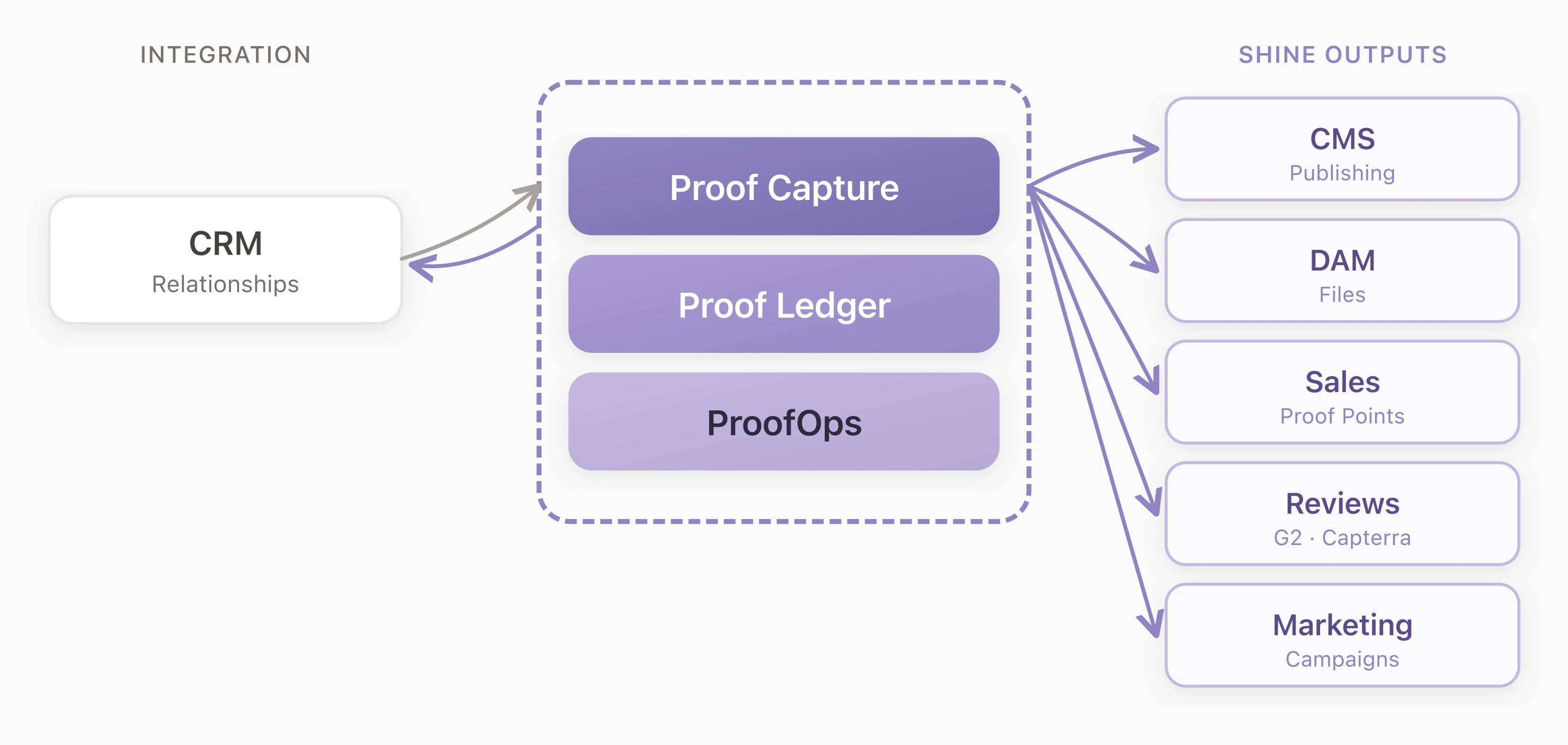
The right question isn't "what does Shine replace?" It's "what does Shine connect?"
**Without Shine**, quotes scatter across Slack, docs, and decks. The same quote gets reformatted from scratch every time someone needs it. And outdated proof quietly erodes trust without anyone noticing.
**With Shine**, there's a single source of truth. One capture powers multiple asset types. And "can we use this?" has an instant answer.
## Where This Becomes Obvious
The gap Shine fills becomes painfully obvious in a few common scenarios:
**Scenario 1: The urgent deal**
Sales needs proof for a specific industry and use case. Marketing scrambles through old decks and shared drives. Nobody knows what's current, what's verified, or what's actually relevant. The deal stalls.
**Scenario 2: The legal review loop**
Legal asks where a claim came from. Marketing says "it was from a customer." Legal asks which customer, when, and whether they approved this use. Nobody can answer quickly. Everything stops.
**Scenario 3: The decay problem**
A powerful quote from two years ago is still being used everywhere. But the customer's contact left the company, the product has changed, and the specific claim no longer applies. Nobody flagged it. Trust erodes quietly.
## Where to Start
**If quotes keep getting used without clear policies:** start with governance. Define who can approve what.
**If nobody knows who owns what:** focus on ProofOps. Map who does what when a customer says something great.
**If capture is the bottleneck:** that's where Shine helps most. It handles proof capture, the ledger, and the workflows, so you get the infrastructure without building it yourself.
The goal isn't to add complexity. It's to make customer proof as operationally mature as the rest of your marketing stack.
## Why This Matters Now
Three trends are making this infrastructure urgent:
**1. AI is flooding the zone with content.**
As AI-generated content becomes ubiquitous, the value of attributable, verified customer proof goes up. Anyone can generate marketing copy. Not everyone can prove their claims come from real customers who actually said those things. In an AI-first world, companies won't just be asked what they claim. They'll be asked where those claims came from.
**2. Buyers are more skeptical than ever.**
Forrester research shows that B2B purchases increasingly stall when buyers can't verify claims. Social proof only works when it's credible. Generic claims and unverifiable quotes don't move deals. Buyers want specificity, context, and evidence they can trust.
**3. The cost of getting it wrong is rising.**
Misused customer quotes, outdated claims, and approval violations create real risk. Legal exposure, customer relationship damage, and brand erosion. As companies scale, these risks scale too.
For the last decade, marketing optimized for speed. AI accelerates that, but breaks trust in the process. As the Edelman Trust Barometer shows, trust now rivals price and quality as a purchase driver. As content becomes cheap, verifiable proof becomes scarce. Customer proof infrastructure isn't a "nice to have." It's a prerequisite for scale.
## Frequently asked questions
**Do I need to rip out my existing tools?**
No. Shine connects to your CRM, DAM, and CMS. It doesn't replace them. It's the proof layer that feeds all of them.
**Does Shine replace our review management tools?**
No. Review platforms like G2 and Capterra host reviews. Shine captures the customer experiences that make reviews easy to write. The reviews still live on the platforms.
**What if we don't have formal governance policies yet?**
Most teams start with Shine and build policies as they go. The visibility into proof creation often clarifies what policies you actually need.